
Preventing Fractures. Extending Lives. Redefining Ageing Safely.
In 2026 alone, OsteoStrong® Australia delivered 55,618 osteogenic loading sessions across our national network.
And since 2019 we have delivered more than 300,000 osteogenic loading sessions in total.
This is not surprising, as globally over the past decade, the OsteoStrong® system has delivered an incredible 14 million sessions worldwide – supported by a significant and proven safety record.
Behind those numbers are real people.
Since 2019, we have safely supported more than 8000 Australian members, including 1,225 new members in 2025.
Many of those members are not starting from a position of strength. They are in the lowest bone health categories — osteopenia and osteoporosis — statistically at the highest risk of falls, fragility fractures, hospitalisation and loss of independence.
Prevented Hip & Other Fractures
Hip fractures, represent one of the most serious health events associated with ageing. They carry high surgical costs, prolonged rehabilitation, and significant mortality risk. For many older adults, a hip fracture marks the beginning of permanent decline.
If we conservatively assume that just 10% of our Australin OsteoStrong® members avoided a hip fracture because of improved bone strength and neuromuscular adaptation, that equates to approximately 800 hip fractures prevented since 2019.
Healthy Bones data suggests that around one third of hip fracture patients do not survive beyond 12 months. On that basis, this could represent over 260 premature deaths potentially avoided.
At an estimated acute medical cost of approximately $30,000 per hip fracture, that alone represents at least $24 million in avoided direct hospital costs without accounting for rehabilitation, aged care, or the immeasurable human cost to families. In fact, the real total societal cost of a hip fracture is estimated at $45,000 to $60,000, which represents a saving of about $42 million, just for hip fractures.
And that calculation reflects hip fractures alone and does not include:
- Vertebral fractures
- Wrist and other fragility fractures
- Reduced falls through improved balance
- Delayed entry into residential aged care
- Improved posture and mobility
- Enhanced metabolic and musculoskeletal health
When the full fracture burden is considered along with their downstream healthcare and aged care costs, it is conservatively estimated that OsteoStrong® has contributed to more than $100 million in direct and indirect medical savings in Australia since 2019.
A Different Approach to Prevention
OsteoStrong® doesn’t fit neatly into a gym category, and it isn’t traditional medical treatment either.
Many of our members have already tried “doing the right thing” — walking regularly, attending Pilates or light gym classes, taking calcium and vitamin D, while watching their diet. These are all positive habits, but do not work for bones.
For women over 60, especially those diagnosed with osteopenia or osteoporosis, they often discover that despite their best efforts, bone density continues to decline.
And while often thought of as a women’s condition, approximately 20% of those living with osteoporosis or osteopenia are men — making bone health a shared concern.
Bone responds to specific mechanical load. Without enough targeted stimulus, it does not strengthen in a meaningful way.
OsteoStrong® is designed to provide that stimulus in a controlled, safe and time-efficient way — helping the body maintain and build strength before fractures occur.
It’s not about pushing harder.
It’s about stimulating smarter.
It’s a shift:
• From hoping bone loss will slow
• To actively supporting structural strength
• From worrying about falls
• To feeling more stable and confident
For most of our members, it’s the first time they feel they are doing something specifically for their bones — not just generally for their health.
The “Side Effects”
And what are the side effects of OsteoStrong’s® approach?
- Stronger bones
- Denser muscle
- Better balance
- Improved agility and posture
- Reduced fall risk
- Reduced glycaemic risk
- Lower visceral fat
- Greater confidence and independence.
And not simply a longer lifespan — but a longer healthspan.
The ability to travel, to lift grandchildren, to remain upright, active and mobile into your 70s, 80s and beyond.
Most importantly, the ability to age without fear of the next fall.
The cost of Inaction
It is also worth reflecting on the alternative.
Sedentary ageing – the gradual migration from activity to the couch – is one of the most powerful drivers of bone loss, muscle decline and fall risk.
While general exercise and nutritional supplementation can support overall wellbeing, most conventional exercise programs do not generate the level of mechanical stimulus required to materially improve bone strength.
In fact, some low impact exercises like swimming and cycling can have the opposite effect because they de-load the skeleton, like walking in space.
Without sufficient osteogenic challenge, structural decline often continues quietly in the background. The consequence is not immediate — it emerges years later as fragility, falls and fractures.
This helps explain why many people who regularly attend gyms, lift weights, practise Pilates, yoga and stretch classes, carefully manage their body weight, follow low-protein vegetarian or vegan diets, and supplement, can still be surprised by an osteoporosis diagnosis.
Activity alone does not guarantee sufficient osteogenic stimulus, and supplementation alone does not ensure structural adaptation. Bone responds to specific mechanical loading – and without adequate intensity and progressive challenge, density usually continues to decline quietly despite good intentions, particularly during menopause.
Prevention is rarely dramatic in the moment, but the cost of inaction is profound as you age.
How Can a Brief Osteogenic Loading Session Once a Week Make Such a Difference?
Bone does not respond to how long you exercise — it responds to how much meaningful load it experiences. OsteoStrong® sessions are brief because the goal is not repetition or fatigue, but precise, high-magnitude stimulus delivered safely.
This principle is grounded in Wolff’s Law, which states that bone adapts to the loads placed upon it. Adaptation is triggered by sufficient mechanical stress — not by the number of repetitions performed. In other words, bone responds to intensity of load, not volume of movement.
While some exercise models emphasise multiple exercises performed several times per week, the core question is not frequency — it is whether the load is osteogenic. A brief properly delivered high-intensity stimulus can be sufficient to trigger adaptation, provided it reaches the required mechanical threshold.
When bone and muscle are exposed to this level of force, the central nervous system responds rapidly. Motor units are recruited more efficiently, muscular firing patterns improve, and the musculoskeletal system adapts by becoming stronger and more resilient.
Importantly, it is not the size of the muscle that matters most — it is its strength and density. Stronger muscles generate greater force through the skeleton, which is what stimulates bone maintenance and growth. At the same time, stronger, denser muscle improves glucose utilisation and metabolic stability, supporting glycaemic and overall metabolic health.
A brief weekly session that reaches adequate load can therefore stimulate both structural and neurological adaptation. The experience of thousands of OsteoStrong® members globally reflects this principle — measurable improvements without the need for high-frequency, high-volume training.
It is not about doing more.
It is about loading enough.
Why High Force Does Not Mean High Risk?
Precise, supervised biomechanical positioning matters.
When you exercise without guidance, your form can easily slip, and your joints can move out of safe alignment. This is why unsupervised gym sessions, lifting weights, and home workouts, which involve repetition, fatigue or high impact, often lead to more injuries — and why many older people stop doing them.
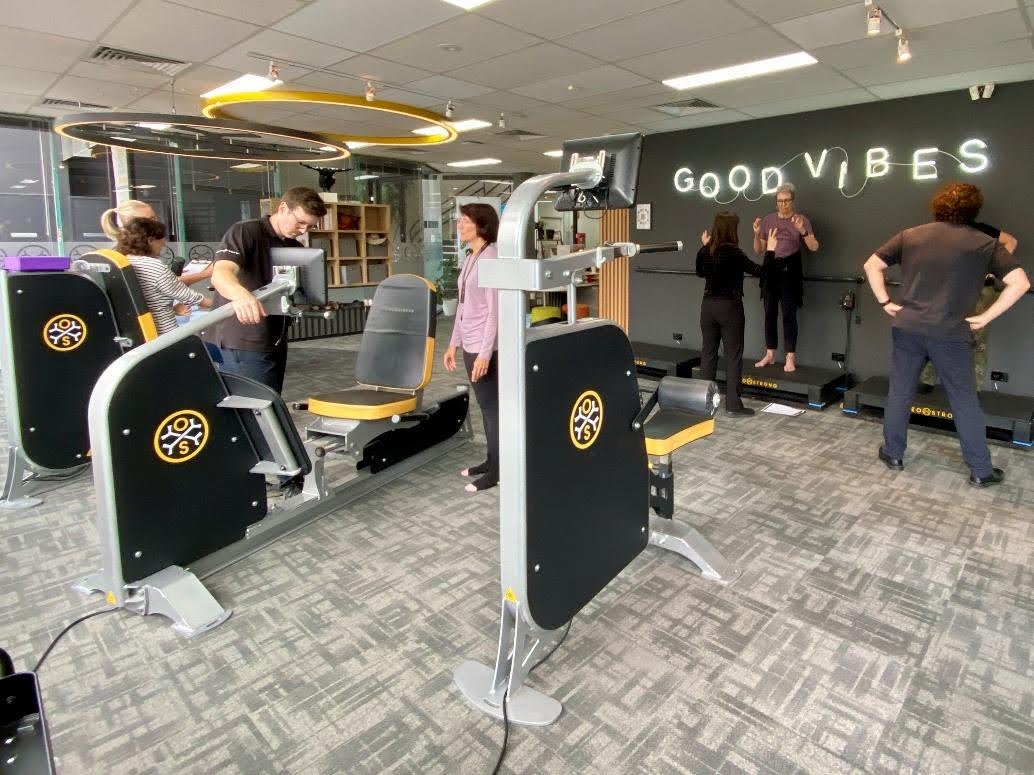
At OsteoStrong, every session is coach-guided, carefully positioned, and self-applied — designed to deliver a powerful stimulus in a highly controlled and safe environment, with the ultimate convenience of one weekly session.
As an example, when your arms or legs are bent at 120 degrees, they are in their strongest mechanically advantageous position — allowing you to safely produce 8 to 10 times greater force than in more vulnerable joint angles.
At OsteoStrong, you apply one brief, slow, controlled effort in this powerful alignment — where joints, tendons and ligaments are supported and force is safely directed through muscle.
Because you’re mechanically advantaged, you can generate significantly higher force output in under 20 seconds — without the need for repeated sets to exhaustion or exposing your body to high-impact loading that substantially elevate injury risks.
A single high-force signal is what scientifically stimulates both muscles and bones to adapt.
Slow. Controlled. Self-applied.
Maximum stimulus. Minimal risk.
Building the Architecture of Longevity
OsteoStrong® is not simply operating a gym for bones.
We are helping to shift the trajectory of ageing in Australia.
More than 300,000 sessions delivered nationally.
More than 14 million globally.
Thousands of members supported.
A substantial growing body of irrefutable evidence based on real data, not small, limited studies.
This is a platform of strength — clinically, commercially and socially with demonstrated improvements in longevity markers including muscle strength (legs in particular), balance, agility, grip strength, and bone density.
Our work continues in 2026.
Because strength is not cosmetic.
It is structural.
And the side effects of strength may be among the most powerful preventative tools of our time.
Take Action Today & Join the OsteoStrong® Revolution
Call us at OsteoStrong® to arrange your complementary session.