
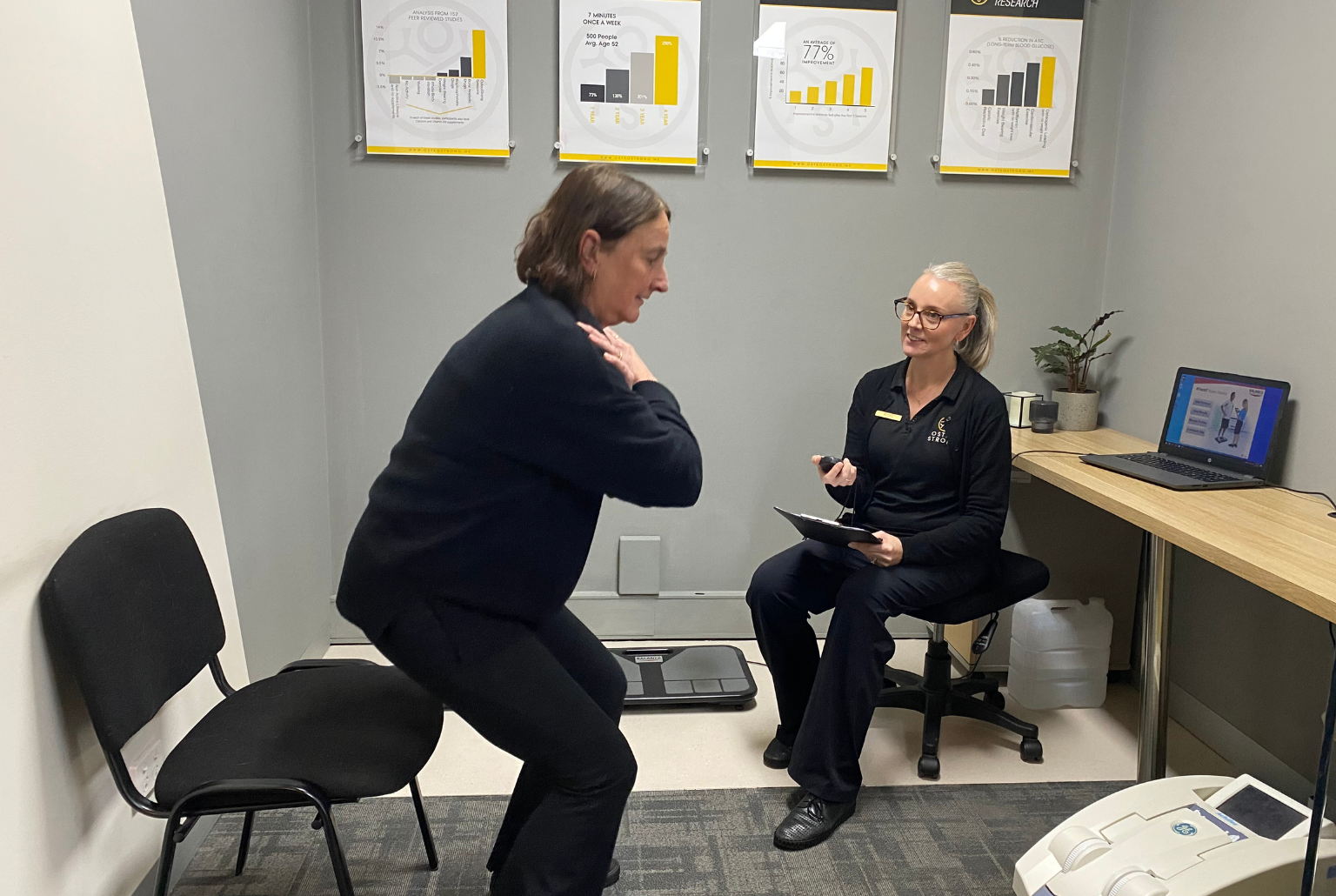
When you start your OsteoStrong program, the first thing you’ll complete is a baseline consultation. As your program progresses, you’ll repeat this consultation approximately every 12 sessions.
While these consultations are a regular part of the OsteoStrong experience, it’s easy to forget exactly why they’re so important. So, what are we measuring, why does it matter, and how does it help you achieve better bone and musculoskeletal health?
What is a baseline consultation?
A baseline consultation is much more than a series of tests—it’s a comprehensive check-in on your health and progress.
During your consultation, one of our coaches will guide you through a range of standardised consultations that measure:
- Functional leg strength
- Grip strength
- Balance
- Stability
These consultations are also an opportunity to:
- Review your progress with the OsteoStrong program.
- Update any relevant health or medical information.
- Discuss any questions or concerns you may have.
- Provide personalised guidance to help you achieve your health goals.
Why are baseline consultations important?
There’s a simple saying that applies perfectly here:
“You can’t manage what you don’t measure.”
By repeating these consultations approximately every three months, we build a picture of how your body is changing over time. Tracking your results allows us to identify improvements, monitor areas that may need extra attention, and provide recommendations tailored to your individual needs.
Sometimes this might mean suggesting a few simple exercises you can do at home to improve strength or balance. In other cases, we may recommend speaking with your GP or another healthcare practitioner if further consultation or support would be beneficial.
Most importantly, these consultations are not a pass-or-fail test.
They simply provide a snapshot of how you’re functioning on that particular day. Everyone starts from a different place, and every result gives us valuable information to help you continue moving forward.
What do we measure—and why?
Grip Strength
Grip strength is one of the simplest yet most powerful indicators of overall muscle strength and functional health.
It can help us:
- Monitor overall strength and musculoskeletal health.
- Review how well your body is aging and how resilient you’ll be in later life as it’s a valuable, evidence-based indicator of longevity.
- Identify potential risk factors associated with frailty, falls, and reduced independence as we age.
Learn more about grip strength here
Single Leg Balance Test
Balance plays a vital role in everyday activities, from walking confidently to navigating stairs safely.
This consultation helps us evaluate:
- Balance and stability.
- Lower limb control.
- Fall risk.
- Improvements in neuromuscular coordination over time.
Postural Sway Test
This test measures how much your body naturally sways while standing still with your eyes closed.
It provides valuable information about how well your:
- Vestibular system (inner ear)
- Proprioception (your body’s awareness of where it is in space)
are working together to maintain balance.
Changes in postural sway can help identify reduced stability and monitor improvements in nervous system function as your strength develops.
Sit-to-Stand Test (Functional Leg Strength)
Standing from a chair may seem like a simple movement, but it relies on good lower body strength and mobility.
This consultation measures:
- Functional leg strength.
- Muscle power and endurance.
- Independence with everyday movements such as standing, climbing stairs, and getting up from the floor.
It also helps us identify changes in lower limb function and monitor improvements over time.
Ultrasonometer
At our master OsteoStrong centres, we use an ultrasonometer to perform an ultrasound scan on your heel for a bone density reading. As this is a screening device only, and not diagnostic, we always encourage members to keep up with their clinical diagnostic scans (either a DEXA or REMS). Please speak to your local centre to find out more about availability, or if you want to learn more about how DEXA results inform your overall bone health progress.
Taking a holistic approach to bone health
Strong bones don’t rely on exercise alone.
Your baseline consultation is also an opportunity to discuss other important factors that influence bone health and overall well-being.
These may include:
Medications
We can discuss bone health medications and encourage conversations with your GP or endocrinologist about whether they’re appropriate for you. We’ll also review any medications that may influence your body’s ability to build bone.
Nutrition
Bones require a range of essential nutrients to remain strong. We’ll discuss how your diet can support healthy bone formation and maintenance. We can help you connect with dietitians or a nutritionist for further support in this area.
Supplementation
If blood tests identify nutrient deficiencies or absorption issues, practitioner-grade supplements may be worth discussing with your healthcare provider.
Exercise
Osteogenic loading through the OsteoStrong program is an important component of bone health, but maintaining muscle mass through other forms of resistance training is equally valuable.
We may also talk about other lifestyle factors that can influence your body’s ability to build and maintain healthy bone, including:
- Sleep quality
- Chronic stress and elevated cortisol levels
- Hormonal health
- Inflammation associated with underlying health conditions
Celebrating your progress
One of the best parts of every baseline consultation is recognising just how far you’ve come!
Not every improvement shows up on a test.
Sometimes it’s feeling steadier when walking upstairs, finding it easier to get up from the floor while playing with your grandchildren, noticing your back feels less sore at the end of the day, or simply feeling stronger and more confident in everyday life.
Those wins matter just as much as the numbers.
At OsteoStrong, our goal isn’t just to collect data—it’s to support, encourage, and celebrate every step of your journey towards stronger bones, better movement, and healthier ageing.