When most people think about hormones, they think about menopause, testosterone, mood swings or perhaps the thyroid. They rarely think about bones or muscles.
Yet hormones are among the most powerful biological signals that determine whether we build or lose muscle, maintain strong bones, store fat, recover from exercise, sleep well or simply have enough energy to enjoy life.
Your endocrine system is your body’s chemical messaging network. It produces hormones that tell your cells what to do and when to do it. Every organ depends on these messages, but bones and muscles are particularly sensitive to them.
As we age, these signals naturally change. Testosterone slowly declines in men. Women experience profound hormonal changes during perimenopause and menopause as oestrogen and progesterone fall. Some people develop thyroid disorders, while chronic stress can keep cortisol elevated for longer than it should be. None of these changes automatically condemn us to poor health, but they do make maintaining muscle and bone more challenging.
This is one reason osteoporosis, frailty and metabolic disease become more common as we get older.
Fortunately, biology works both ways.
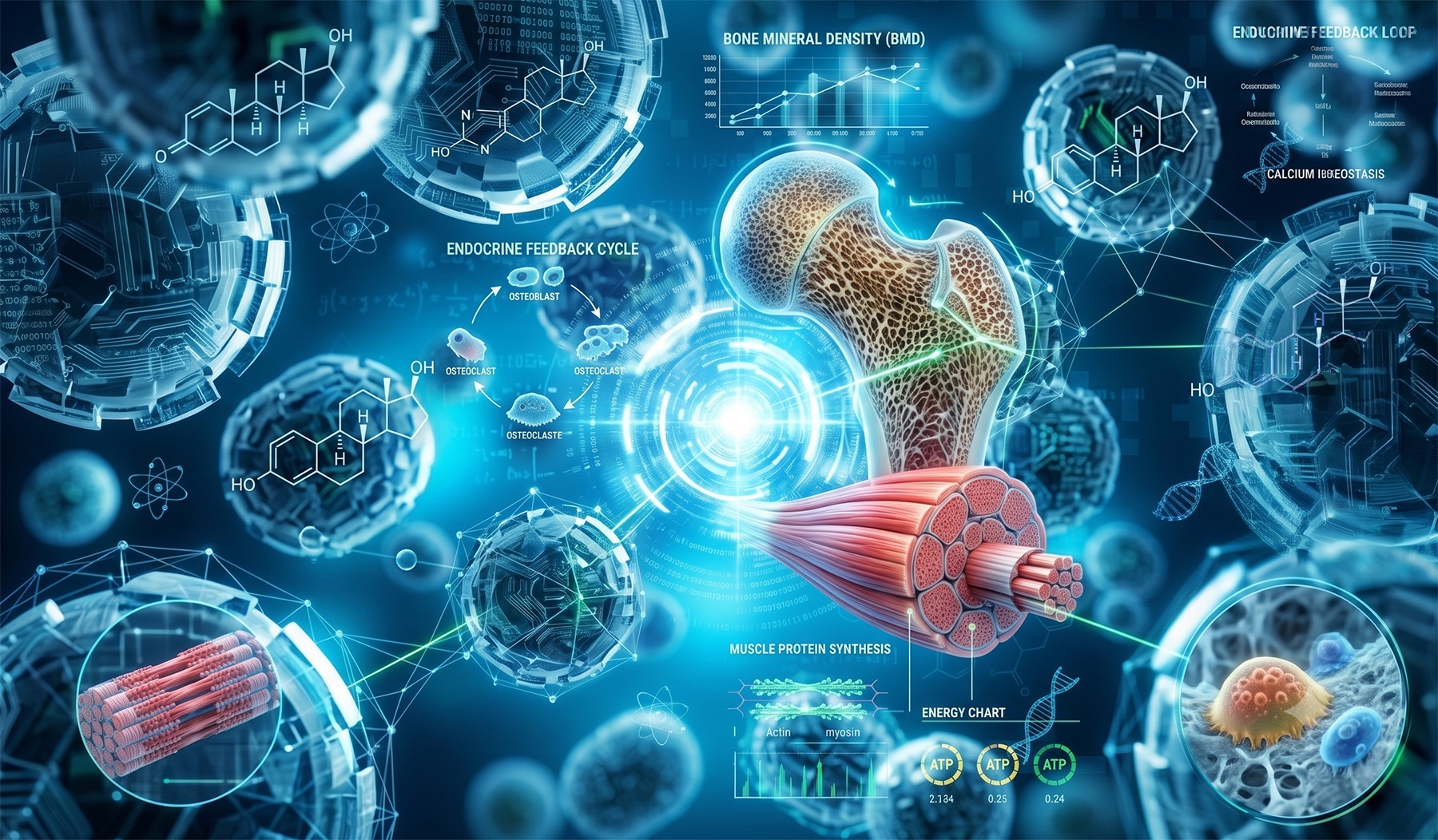
Just as hormones influence muscle and bone, muscle and bone also influence hormones.

When you place your body under an appropriate mechanical load, something remarkable happens. Your muscles don’t simply become stronger. Your skeleton doesn’t simply become denser. Exercise stimulates an entire cascade of biological signals. Muscles become more sensitive to amino acids, helping repair and growth. Bones activate the cells responsible for remodelling. Insulin sensitivity improves. Stress hormones become better regulated. Depending on the type and intensity of exercise, testosterone and growth hormone may temporarily increase, helping support repair and adaptation.
This is why the right stimulus matters.
A gentle walk has enormous benefits for cardiovascular health and mental wellbeing, but it is unlikely to provide enough mechanical loading to significantly strengthen ageing bones. Likewise, lifting weights that are far below your body’s adaptive threshold may improve movement without giving your skeleton much reason to change.
Your biology always asks one question:
“Do I need to adapt?”
If the answer is yes, it begins rebuilding.
If the answer is no, it slowly conserves energy by allowing muscle and bone to decline.
Unfortunately, modern life is sending our endocrine system many mixed messages.
Today we are surrounded by thousands of synthetic chemicals in plastics, food packaging, pesticides, cosmetics, cleaning products, furnishings and industrial materials. Scientists refer to some of these as endocrine-disrupting chemicals because they can interfere with normal hormone signalling. BPA, certain phthalates and PFAS are among the best studied examples.
This doesn’t mean every plastic container or every household product is super dangerous. Dose, duration and timing all matter. But reducing unnecessary exposure simply makes good sense. Swapping out plastic containers for glass, and plastic spoons and scrappers for silicon and stainless steel is a great start.
The same applies to food.
Choosing whole foods over highly processed foods reduces exposure to many unnecessary additives while improving nutrition. Washing fruit and vegetables, eating a wide variety of foods, choosing organic where practical and affordable, and using glass or stainless-steel containers instead of heating food in plastic are all sensible, low-risk strategies. The same with reducing the Dirty Dozen vegetables and fruits which have highest pesticide levels and increasing the Clean 15 varieties is a great start.
The goal isn’t perfection.
The goal is reducing unnecessary biological noise.
Soy is a good example of why we need to avoid health myths. It is often blamed for lowering testosterone and increasing oestrogen in men. However, the best available human studies have found that normal dietary soy consumption does not significantly affect testosterone or oestrogen levels in healthy men. This doesn’t mean every processed soy product is ideal, but it does remind us to question headlines before accepting them as fact.
The same balanced thinking applies to many environmental toxins. Some deserve our attention. Others receive far more publicity than the evidence supports.
The challenge is knowing the difference.
Perhaps the most important message is this:
You cannot completely eliminate environmental toxins.
But nor do you need to be paranoid.
Your liver, kidneys, lungs and digestive system are already extraordinary detoxification organs. Rather than chasing expensive “detox” programs, you’re usually far better off supporting the systems you already have. Eat adequate protein. Include plenty of fibre. Stay hydrated. Sleep well. Exercise regularly. Maintain a healthy gut. Minimise smoking, excessive alcohol and unnecessary chemical exposure where practical.
Your body has evolved remarkable repair systems.
It simply needs the right conditions to use them.
It is also worth acknowledging that some people are far more sensitive to environmental chemicals than others. Conditions such as Sick Building Syndrome and Multiple Chemical Sensitivity can have a profound impact on quality of life. While the science continues to evolve, there is little doubt that these individuals experience genuine symptoms.
They are, however, the exception rather than the rule. We shouldn’t dismiss genuine illness, but neither should we allow fear of every chemical to become another chronic source of stress. Most of us are unlikely to become ill from everyday exposures alone, but that doesn’t mean we should ignore unnecessary chemical exposure. As with so much of health, the sensible approach lies somewhere between complacency and paranoia.
Reduce avoidable risks where practical, support your body’s natural defence systems, and remember that the greatest drivers of healthspan remain the basics—good nutrition, regular movement, quality sleep, stress management and maintaining strong bones and muscles.
This brings us back to the principle that runs throughout healthy ageing.
Every decision is a biological signal.
The products you use, the food you eat, the quality of your sleep, your stress levels, your exercise and even the environment you live in are all sending messages to your endocrine system.
Some signals promote resilience.
Others promote decline.
None acts alone.
Hormones, muscles and bones are constantly talking to each other. When that conversation is healthy, you become stronger, more resilient and more metabolically healthy. When the conversation is disrupted—by inactivity, poor nutrition, chronic stress or unnecessary environmental exposures—adaptation becomes more difficult.
The encouraging news is that your biology is remarkably forgiving.
You don’t need to eliminate every toxin or buy every organic product to improve your health. The greatest gains still come from the basics done consistently: resistance exercise that provides an adequate stimulus for muscles and bones, sufficient protein, quality sleep, effective stress management and minimising unnecessary chemical exposure where it is practical to do so.
Healthy ageing isn’t about living in a bubble.
It’s about sending your body thousands of positive biological signals that, over time, outweigh the negative ones.
Because your hormones are listening.
And so are your bones and muscles.
Contact your nearest OsteoStrong® Centre today to find out how we can support your healthy aging journey.