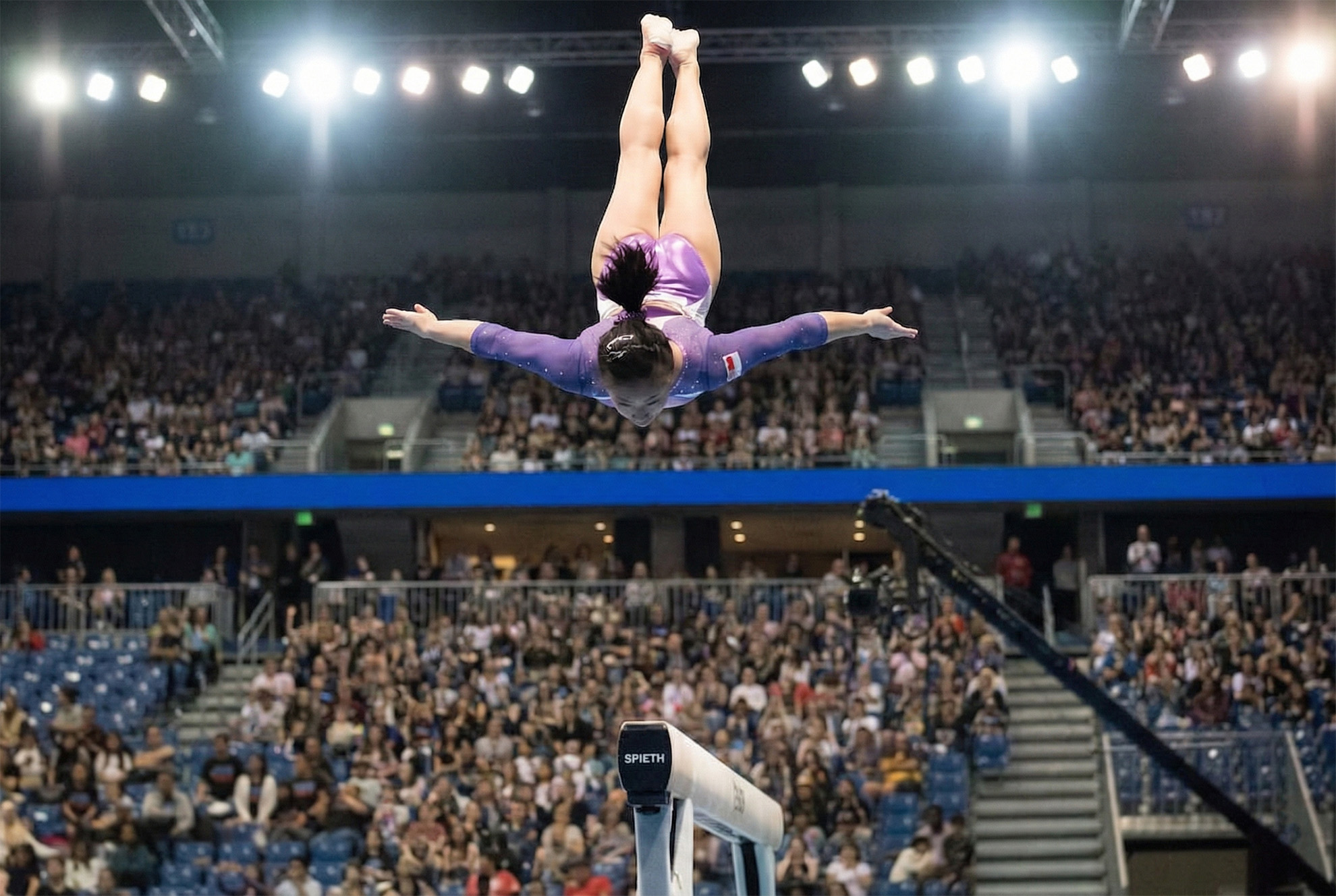
In 1998, Bass et al. published a landmark study (1) in the Journal of Bone and Mineral Research examining active prepubertal gymnasts and retired adult gymnasts.
The finding was profound
Girls who trained in high-impact gymnastics before puberty developed significantly higher bone density — and importantly, many of those skeletal benefits persisted into adulthood, even after they stopped training.
Let that sink in
The body doesn’t respond to how often you move. It responds to how much load you apply.
Bone adapts to mechanical strain. When the load is high enough, it triggers an adaptive response. If the load is too low, nothing changes — no matter how frequently you repeat it.
That’s the real lesson from this study. But here’s the critical point most people miss:
Gymnastics works because of the magnitude of force — not because of volume or frequency.
And gymnastics comes with very high injury rates.
It involves repetitive impact, joint stress and risk that is completely inappropriate for:
- Deconditioned and older adults
- Post-menopausal women
- Individuals with osteopenia or osteoporosis
- Those with reduced muscle mass or balance confidence
- Most people with metabolic condition who may be overweight
Women in particular tend to have lower lifetime muscle mass and strength compared to men, placing them at greater fracture risk as they age. High-impact sport is neither realistic nor safe for most older adults.
What is the solution?
You need sufficient load to stimulate bone.
But you need it applied:
- In a controlled safe environment
- In a biomechanically strong position
- Without high-impact repetition
- Without exhaustion
- Without injury risk
That is the OsteoStrong model.
Once per week.
Because frequency is not the driver. Magnitude is.
A brief, high-force, controlled osteogenic loading session provides the signal the body needs to adapt — without the repetitive impact and injury exposure seen in elite sport.
The gymnast study proves the principle.
OsteoStrong applies it safely. Strong bones are not built through endless repetition.
They are built through sufficient stimulus — applied intelligently.
(1) JOURNAL OF BONE AND MINERAL RESEARCH Volume 13, Number 3, 1998 Blackwell Science, Inc. © 1998 American Society for Bone and Mineral Research Exercise Before Puberty May Confer Residual Benefits in Bone Density in Adulthood: Studies in Active Prepubertal and Retired Female Gymnasts S. BASS,1,2 G. PEARCE,1 M. BRADNEY,1 E. HENDRICH,1 PIERRE D. DELMAS,3 A. HARDING,4 and E. SEEMAN