
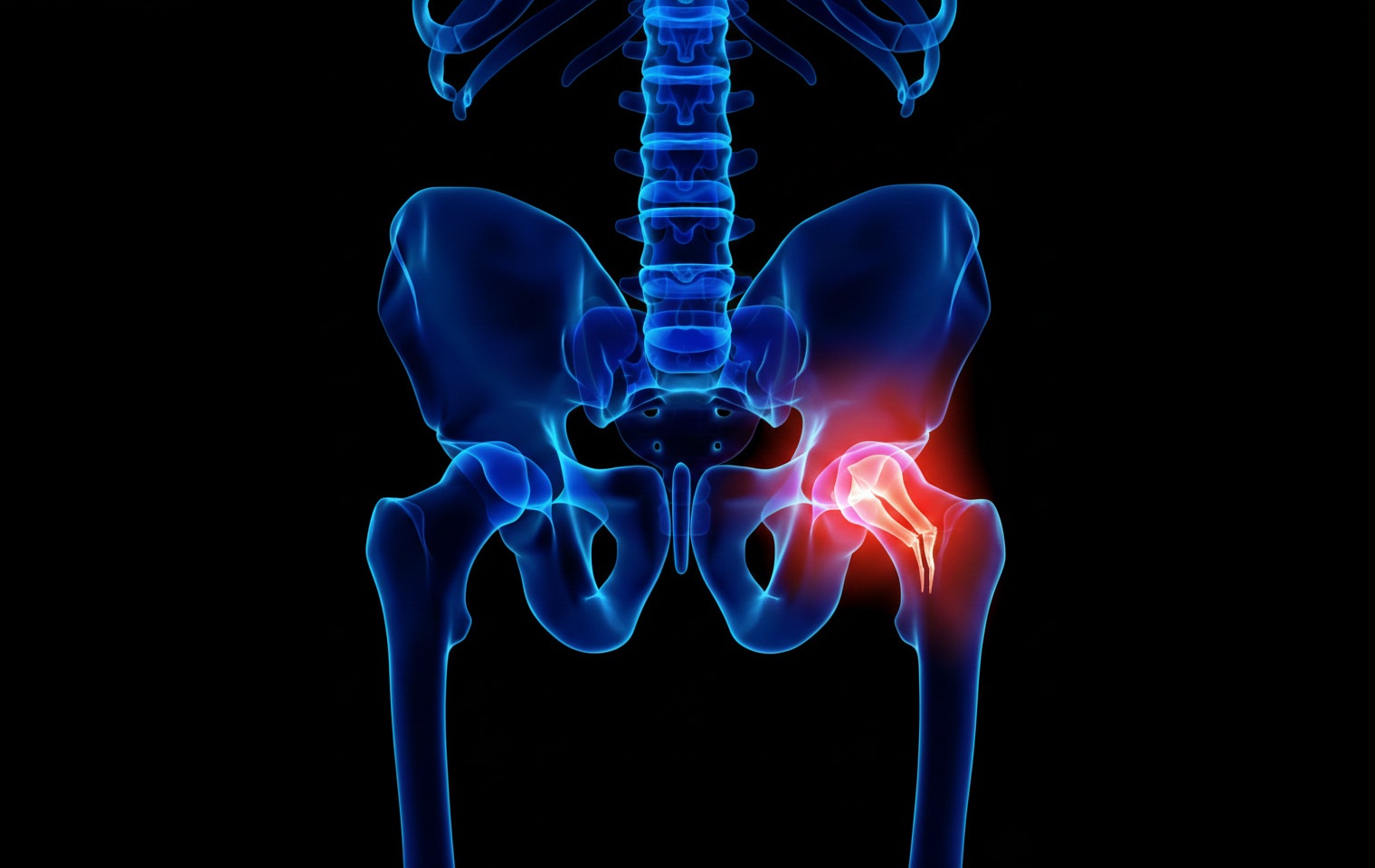
When someone breaks a hip, we often say:
“They fell and broke their hip.”
But in many cases — particularly in older adults — the sequence is often the reverse.
In up to 20% of cases the hip fractures first. Then they fall.
A Silent Process Decades in the Making
Bone is living tissue. It constantly renews itself through a tightly regulated process of:
- Resorption – old or micro-damaged bone is removed
- Formation – new bone is laid down
This remodelling process maintains the strength, flexibility, and shock-absorbing capacity of the skeleton.
Over decades, if breakdown outpaces formation, bone mass, and bone quality decline. The internal scaffolding thins. The cortex weakens. Micro-damage accumulates.
There are no warning lights – until something small happens:
- Stepping off a curb
- Twisting to turn around
- Pivoting while carrying groceries
- Simply shifting weight
This is called a low-trauma fragility event.
And the bone fails and fractures.
The Fracture Often Happens First
In many hip fracture cases:
- The weakened femoral neck fractures.
- Sudden structural collapse occurs.
- The person falls.
- The fall is recorded as the cause.
But the true cause was structural bone weakness.
Once the fall occurs, additional injuries may follow:
- Head trauma
- Wrist fractures
- Shoulder fractures
- Forearm fractures
The hip fracture starts the cascade.
The Drug Paradox: Suppressing Turnover
Many commonly prescribed osteoporosis medications — particularly anti-resorptive drugs — work by suppressing bone breakdown.
Examples include:
- Alendronate
- Zoledronic acid
- Denosumab
These medications reduce osteoclast activity and slow bone resorption.
In the short to medium term, this can improve bone density scores (DEXA score) and reduce certain fracture risks.
However, bone turnover exists for a reason, to;
- Repairs microscopic cracks
- Maintains material quality
- Preserves elasticity
- Prevents accumulation of aged bone
With prolonged suppression, turnover can become markedly reduced. Some bisphosphonates bind to bone for years, with measurable biological effects persisting long after treatment stops — sometimes close to a decade.
Concerns raised in long-term literature include:
- Accumulation of older, more mineralised bone (healthy bone is up to 40% non-mineral)
- Reduced micro-damage repair
- Increased brittleness
- Rare atypical femoral fractures
Bone is not meant to be frozen in time.
It is meant to adapt.
The Mortality Reality
Hip fractures are not simply orthopaedic injuries. They are systemic events.
Outcomes are influenced by:
- Muscle mass and strength
- Balance and neuromuscular control
- Cognitive function
- Cardiometabolic health
- Medication burden
After a hip fracture, we commonly see:
- Rapid muscle wasting
- Loss of independence
- Pneumonia
- Blood clots
- Acceleration of frailty
The statistics are sobering:
- Around one-third of women over 60 die within 12 months of a hip fracture.
- Up to half of men over 70 die within a year.
A broken hip is often the tipping point of long-developing fragility.
The Missing Piece: Mechanical Stimulus
Bones do not grow stronger from suppression.
They grow stronger from load.
And most people do not understand that it’s not the frequency of loading, it’s the magnitude of the load.
Under Wolff’s Law, bone adapts to the mechanical forces placed upon it. Without sufficient osteogenic loading, bone does not receive the signal to remodel upward.
This is where OsteoStrong® differs fundamentally from drug-based approaches.
OsteoStrong® works by:
- Delivering targeted, very safe, emulated high-force osteogenic loading without risky high impact
- Stimulating natural bone formation
- Supporting healthy turnover rather than suppressing it
- Enhancing muscle strength and density
- Improving neuromuscular coordination and balance
This is critical.
Because fracture prevention is not just about bone density.
It is about:
- Bone quality
- Muscle strength
- Stability – balance
- Reaction time – agility
- Confidence to stay active
By strengthening both the skeletal and muscular systems, meaningful reductions in fall risk and fracture risk can be achieved.
No pharmaceutical drug can:
- Increase muscle strength
- Improve balance
- Enhance neuromuscular control
- Restore functional loading capacity
Drugs may modify density numbers.
But they do not rebuild the integrated bone-muscle system.
The Real Question
Instead of asking:
“How did they fall?”
We should ask:
“Why did the bone fail under such a small load?”
True prevention addresses:
- Natural bone remodelling
- Mechanical strength
- Muscle mass
- Balance and coordination
- Metabolic resilience
Not just suppression of breakdown.
The Important Lesson
Many hip fractures do not happen because someone fell.
They fall because the hip fractured.
That fracture is usually the endpoint of decades of silent decline — in bone strength, muscle mass, and neuromuscular capacity.
The opportunity lies earlier.
Before the curb.
Before the twist.
Before the fall.
This article reflects current scientific understanding and is for general educational purposes only. It should not be relied upon as individual medical advice.