Bone health is not built on exercise alone.
Osteogenic loading is powerful — but it is only one of the four pillars of bone health:
- Nutrition – primarily protein + micronutrients
- Medical – medical conditions, medication, and hormonal status
- Lifestyle – smoking, alcohol, stress etc.
- Exercise – adequate stimulus to trigger osteogenesis for bone health
When plant-based diets are carefully structured, they can work. But when they are unmanaged, the risks to muscle and bone health increase — particularly with ageing.
Ageing and Metabolic Efficiency
As we age, our bodies become less efficient at:
- Digesting and absorbing protein
- Synthesising muscle protein
- Activating vitamins
- Maintaining mineral balance
Research on anabolic resistance shows:
- By age 60, muscle protein synthesis efficiency is roughly 20–30% lower.
- But by age 80, it may be 40–50% lower, meaning higher-quality protein and stronger stimulus are required to achieve the same result.
We also see reduced absorption of B12, iron and zinc, and impaired vitamin D activation. In short: precision matters more with age.
The Protein Quality Problem
It’s not just about total protein. It’s about:
- Complete essential amino acid (EAA) profile
- Bioavailability
- Digestibility
- Leucine threshold
Muscle protein synthesis requires 2.5 to 3 g of leucine per meal to activate. Bone matrix integrity depends on adequate lysine and methionine, critical for collagen cross-linking.
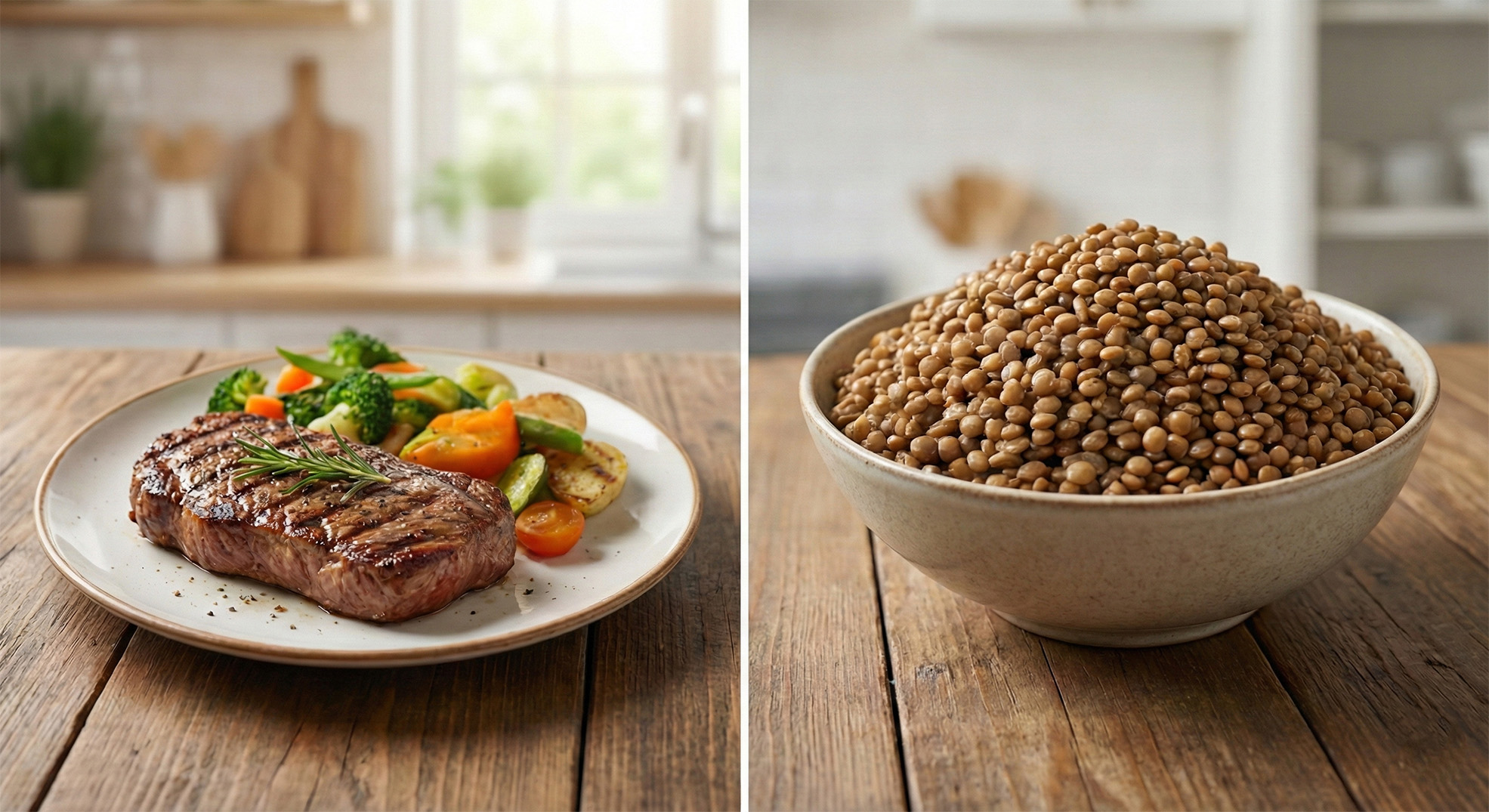
Example Comparison
🥩 200 g Cooked Grass-Fed Beef
- 50 g protein
- DIAAS: 1.1
- 4 g leucine (exceeds daily requirement)
- High lysine & methionine
- Bioavailable iron, zinc, B12
- 475 kcal
- About 50 g usable complete amino acids
Nearly all protein is available for tissue repair and maintenance.
🌱 500–600 g Cooked Lentils
- 50 g protein (label value only)
- DIAAS: ~0.5
- Less than 3.5 g leucine & less bioavailable (below daily requirement)
- Lower methionine & cysteine
- Reduced digestibility
- 700 kcal (47% higher calories)
- About 27 g usable complete amino acids
This confirms that when adjusted for protein quality, lentils providing 50 g of labelled protein deliver almost 85% fewer usable essential amino acids due to lower digestibility and a lower DIAAS score. Lentils also supply significantly more total calories — approximately 47% higher for the same 50 g labelled protein — with most of those additional calories coming from carbohydrate.
In today’s dietary environment, already saturated with processed carbohydrates, the difference in amino acid bioavailability and overall caloric load becomes increasingly relevant for those focused on muscle preservation, metabolic health, insulin resistance, and long-term bone strength.
Why This Is Especially Relevant for Women
Many women who follow long-term vegetarian or vegan diets also tend to have:
- Smaller body frames
- Smaller bone size
- Lower peak bone mass
- Lower lifetime mechanical loading
- Lower Type II muscle fibre development
Activities such as Pilates and light resistance/weight training are beneficial for posture and control — but often do not sufficiently stimulate Type II fibres required for strength, power, and fracture prevention.
Compounding this, many women begin heavy resistance training later in life — often only after a diagnosis of osteopenia or osteoporosis — meaning decades of lower mechanical loading have already passed.
If dietary protein quality is also suboptimal, the ability to rebuild muscle and bone becomes even more challenged.
This underscores the importance of the recent U.S. regulatory review suggesting that older adults with compromised muscle and bone health may require up to 2 g of protein per kilogram of body weight per day.
By comparison, the current Australian RDA — 0.7 g/kg for women and 0.8 g/kg for men — may be insufficient to support optimal muscle maintenance and bone integrity in ageing populations.
The Important Take-away
Exercise provides the stimulus.
Nutrition provides the building blocks.
Osteogenic loading is essential — but it cannot overcome chronic deficiencies in essential amino acids or micronutrients.
Vegan and vegetarian diets can absolutely work — but only when:
- Protein quality is carefully and deliberately managed
- Leucine thresholds are met
- EAAs are sufficient
- B12, iron and zinc are addressed
It’s not “protein grams” that matter most.
It’s usable amino acids — especially as metabolic efficiency declines and lifelong mechanical loading patterns compound over time.
When muscle is the currency of ageing, quality becomes critical.
Talk to us at OsteoStrong to find out how you can stay stronger as you age.