There is a growing push across health, food and environmental circles to eat less meat.
Some of that conversation is valid.
Highly processed food has become one of the great nutritional disasters of the modern world. Ultra-processed meals, refined carbohydrates, seed oils, sugars, preservatives, fillers and fake “health” foods have helped create a population that is overfed, undernourished and metabolically unwell.
But somewhere in that conversation, meat has been dragged into the same basket.
That is where the discussion becomes too simplistic.
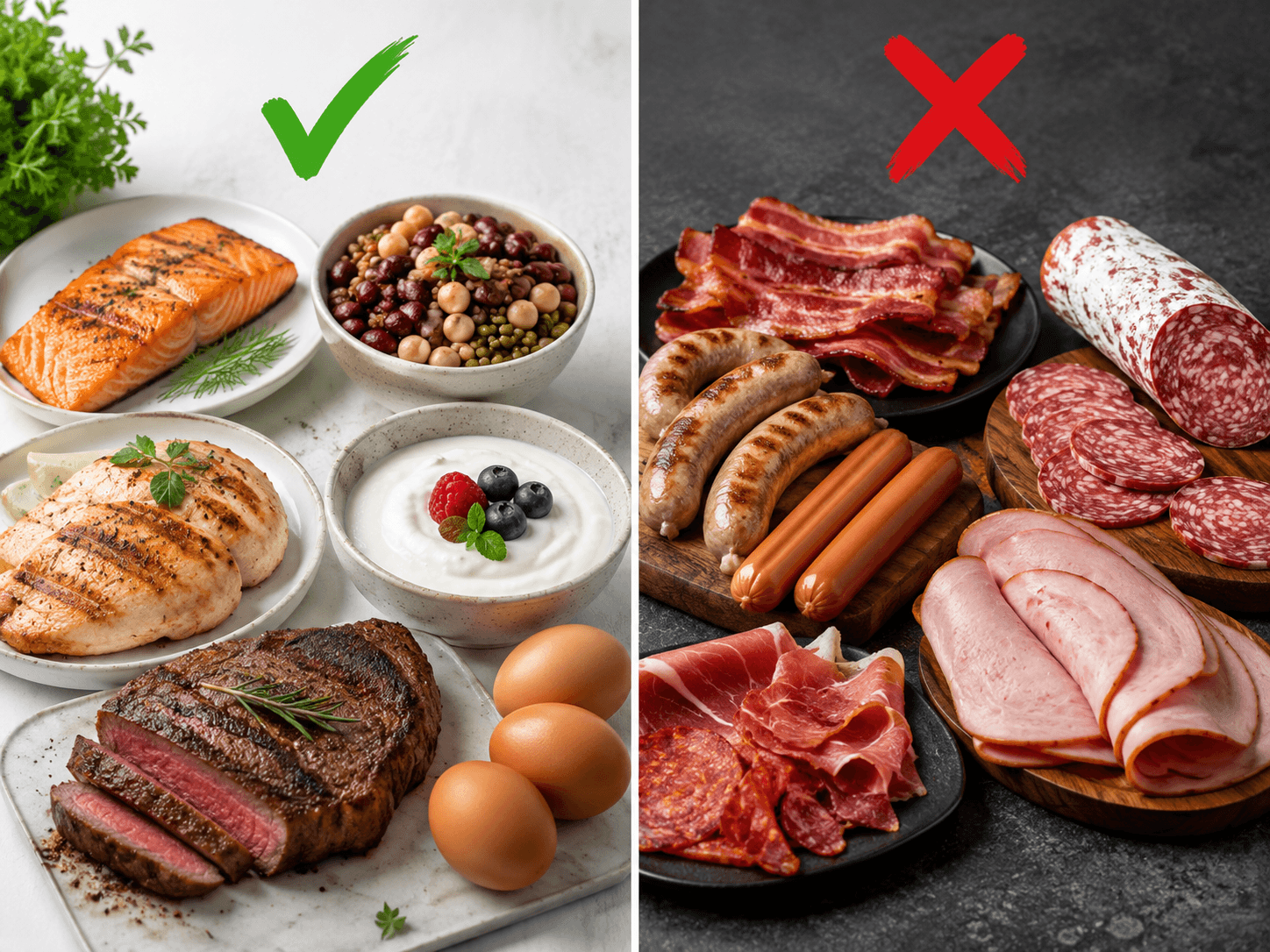
Because there is a world of difference between a heavily processed meat product and a quality piece of grass-fed beef, lamb, fish, eggs or other whole-food protein.
One is manufactured, the other is nutrient-dense food.
Yet too often, they are spoken about as if they are the same thing. They are not!
Processed Meat Is Not the Same as Real Meat
Much of meat’s bad reputation comes from studies and commentary that group very different foods together.
Processed meats are usually cured, smoked, salted, preserved or manufactured to improve taste and shelf life.
That means bacon, salami, sausages, hot dogs, deli meats and many mass-produced meat products may contain preservatives, fillers, poor-quality fats, nitrates, excess salt and chemical by-products from processing or high-temperature cooking.
That is very different from a piece of grass-fed steak, slow-cooked lamb, pasture-raised eggs or fresh fish.
So when people say “meat is bad for you”, the first question should be:
What meat, is it processed meat, is it factory-farmed grain fed or finished, is it burnt or smoked meat?
Is it eaten with chips, soft drink and white bread?
Or is it clean, whole-food protein eaten with vegetables, minerals, healthy fats and a nutrient-dense diet?
Because those are not the same meals.
And they are unlikely to create the same result in the body.
The Saturated Fat Argument Is Not the Whole Story
For decades, meat has been criticised largely because of saturated fat.
But human biology is not that simple.
The health impact of food is not determined by one nutrient in isolation.
It depends on the whole food, the quality of the animal, the farming method, the processing, the cooking method, the rest of the diet, metabolic health, inflammation, insulin resistance, activity levels and age.
A cheap processed meat product (hot dog) in a refined white bun with sauce, seed oils and fries is not the same as grass-fed beef eaten with vegetables and minerals.
Grass-fed and organic meat does not mean “eat unlimited meat and ignore everything else”.
But it does challenge the lazy idea that all meat is the same.
Protein Is Not Optional as We Age
As we age, protein becomes more important, not less.
This is where the modern food conversation can become dangerous.
People are told to “eat less meat” without being taught how to replace the protein properly.
So they remove steak, eggs, fish or chicken and replace them with toast, cereal, pasta, rice, almond milk, oat lattes, crackers, plant snacks and a few beans.
That is not a high-protein diet.
That is often a low-protein, high-carbohydrate diet wearing a health halo.
And the body pays the price.
. Muscle declines.
. Bone weakens.
. Balance deteriorates.
. Metabolism slows.
. Falls become more dangerous.
. Recovery becomes harder.
. Confidence shrinks.
. This is not healthy ageing.
. This is quiet biological decline.
Even updated US dietary guidance now reflects a stronger protein message, moving beyond the old minimum target of around 0.8 grams per kilogram of body weight and pointing many adults toward a higher range of approximately 1.2 to 1.6 grams per kilogram per day.
That shift matters.
Because protein is not just about avoiding deficiency.
It is about preserving muscle, supporting bone, maintaining metabolism, improving recovery and protecting independence as we age.
Plant Protein Can Help — But It Must Be Done Properly
This is not an argument against plant foods.
Vegetables, legumes, nuts, seeds, fruit, herbs and fibre-rich foods can all be valuable parts of a healthy diet.
But replacing animal protein with plant protein is not always a simple one-for-one swap.
Many plant proteins are lower in essential amino acids, especially leucine, which is one of the key triggers for muscle protein synthesis.
They can also be harder to digest, require larger food volumes, and may not deliver the same protein density as animal foods.
That becomes especially important as we age, because ageing muscle becomes less responsive to protein.
This is called anabolic resistance.
In simple terms, the body often needs a stronger protein signal as we get older to achieve the same muscle-building response.
So if someone removes meat and does not carefully replace it with enough high-quality protein, they may think they are making a healthy choice while slowly losing the very tissue that protects them – Muscle.
Muscle Is Metabolically Protective
Muscle is not just there to make you look strong;
. Muscle is a metabolic organ.
. It helps regulate blood glucose.
. It stores glycogen.
. It improves insulin sensitivity.
. It supports balance, strength, mobility and independence.
. It protects joints.
. It helps recovery.
Muscle is one of the most important tissues for healthy ageing. The less muscle you have, the smaller your metabolic engine becomes.
The more muscle you preserve, the more resilient you become.
That is why muscle is one of the great protective assets of ageing.
And it needs two things:
1. The right stimulus.
2. And the right building blocks.
Muscle responds to the amount of force placed through it. That is the key difference between OsteoStrong and conventional exercise.
At OsteoStrong, the body can safely generate much higher force, giving muscle a stronger signal to adapt, grow denser and become more powerful.
The building blocks are protein, minerals, hormones, sleep, sunlight and recovery.
Without enough protein, the body cannot maintain the structure it is being asked to build.
The Source of Protein Matters
The source of protein also matters significantly.
Processed meat is not the same as grass-fed meat.
A sausage in a white bun is not the same as a grass-fed steak.
A factory-made meat product is not the same as eggs, fish, lamb, beef or chicken eaten as part of a nutrient-rich diet.
And a plant-based diet is not automatically healthy unless it is properly planned to deliver enough total protein, essential amino acids, vitamin B12, iron, zinc, iodine, omega-3 fats, minerals and calories.
The issue is not ideology, it is biology.
Your bones do not care about food politics.
Your muscles do not care about marketing trends.
Your metabolism does not care whether a packet says “plant-based”, “natural” or “heart healthy”.
Your body responds to nutrients, load, hormones, energy, inflammation and recovery.
The Better Question
Instead of asking:
“Should we eat meat or not?”
We should be asking:
“Are we getting enough high-quality protein to protect our bones, muscles and metabolism as we age?”
Because the real danger for many older adults is not eating too much quality protein.
It is eating too little.
And the result is not just a number on a blood test.
It is weaker bones.
Less muscle.
Poorer balance.
Slower metabolism.
Higher fall risk.
Loss of independence.
And a poorer ageing result.
At OsteoStrong, we believe ageing well requires a stronger conversation.
Not just about calories.
Not just about weight.
Not just about eating less.
But about building and preserving the tissues that keep us alive, mobile and confident.
Because muscle is metabolically protective.
Bone is living tissue.
And your skeleton is not optional.