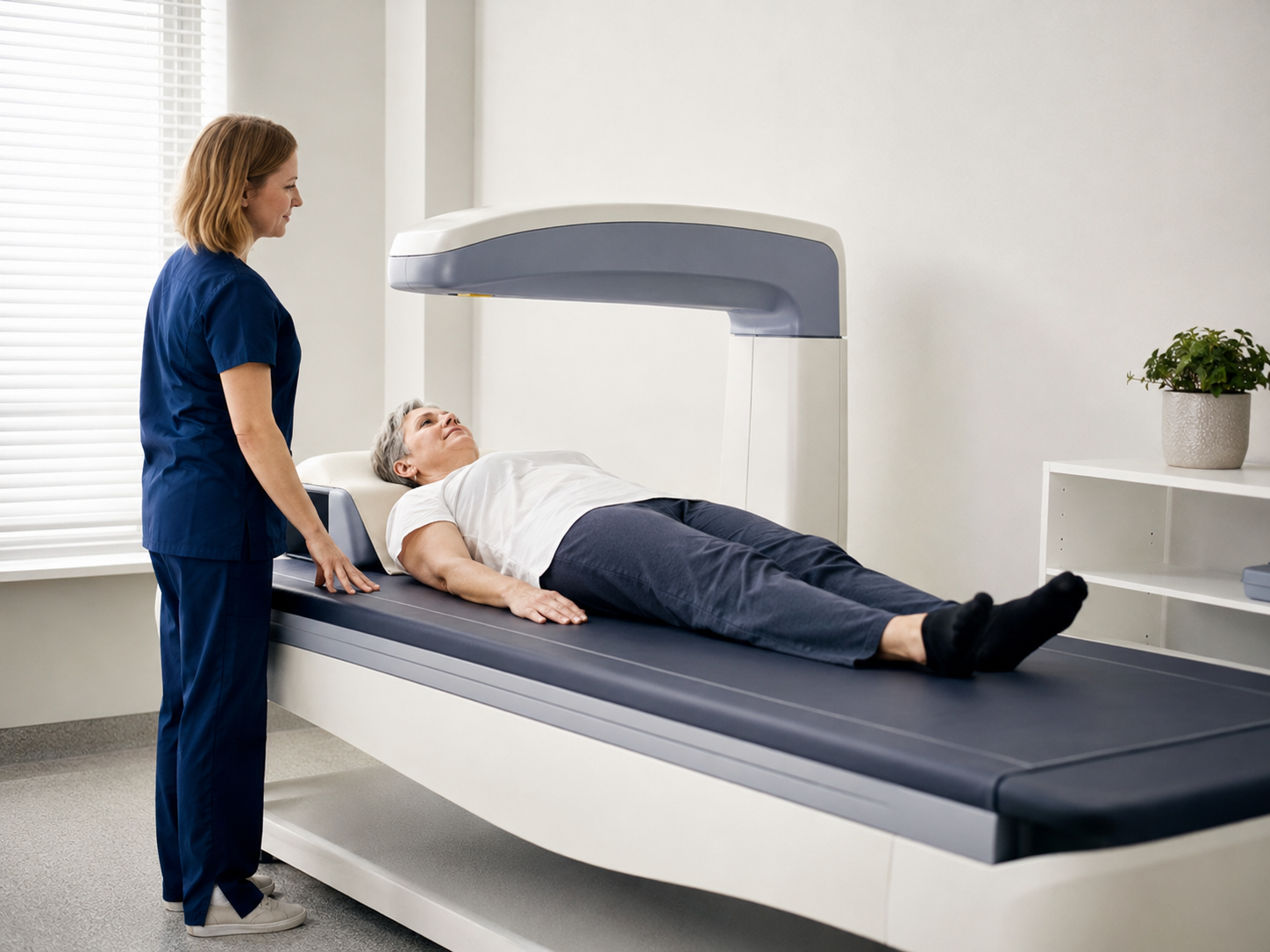
For decades, poor bone health has been treated mainly as a bone-density problem.
Get a DEXA scan.
Look at the T-score.
Compare the number.
Prescribe something to improve the number.
Repeat the scan.
But here is the uncomfortable truth:
A better DEXA result does not automatically mean a reduced fracture risk.
A DEXA scan measures bone mineral density. It does not measure bone quality or strength. It does not measure balance. It does not measure whether you can recover when you trip, stabilise your hips, absorb impact, or get yourself off the floor.
And most fractures do not happen because someone was standing still with a low T-score.
They happen because someone falls and lands hard.
The Mathematics of a Small DEXA Change
Let’s keep the maths simple.
Imagine two groups of people.
One group receives no drug treatment.
The other group receives a bone medication.
At the end of the study, the drug group shows a 2-3% improvement in bone density compared with the reference group.
On paper, that sounds positive.
But in real life, what does a 3% DEXA improvement in isolation really mean?
One review gave the example of hip fractures falling from 12 per 1,000 women over 6 years to 8 per 1,000 — a relative reduction that sounds large, but an absolute difference of 4 fewer fractures per 1,000 people, or just 0.4%.
(https://pmc.ncbi.nlm.nih.gov/articles/PMC9108104/?utm_source=chatgpt.com)
An increase in bone amount may not automatically mean an increase in bone strength. Bone is not just a mineral deposit; it is living tissue that needs healthy turnover.
The body must constantly remove older, more brittle bone and replace it with younger, more flexible, better-quality bone.
Simply accumulating more bone mineral may improve a DEXA score, but if that bone is old, dense and brittle, it may do little to reduce real-world fracture risk. True fracture prevention depends on more than density.
It depends on bone quality, muscle strength, balance, reaction time, fall risk, impact force and overall health. A stronger, steadier person with better muscle power and balance is less likely to fall — and more likely to survive a stumble without breaking — than someone who has only achieved a marginally better scan result.
If one person’s DEXA score moves from 100 to 103, the scan has improved, but what does this really mean?
Can they get out of a chair more easily?
Can they stand on one leg?
Can they walk without shuffling?
Can they react quickly when they stumble?
Can their muscles protect their hips during a fall?
Can their tendons and ligaments stabilise their joints?
Can they generate enough force through their legs to avoid collapsing?
If the answer is no, then the most important part of fracture prevention has not really changed at all.
The number moved. But the change is possibly insignificant.
Fracture Risk Is Not Just Bone Density
Fracture risk is not one thing.
It is an equation.
Fracture risk = bone quality + muscle strength + balance + reaction time + fall risk + impact force + overall health
DEXA only measures one part of that equation.
It tells us something about bone density, but it does not tell us whether the person is physically capable, stable, powerful, coordinated or resilient. DEA is in fact a quantitative scan, not a qualitative scan.
That is why relying only on DEXA can create a false sense of security.
A person may be told their scan has improved, yet they may still have weak legs, poor balance, low muscle mass, slow reaction time and a high risk of falling.
In that situation, the fracture risk may remain dangerously high, and will continue to get worse over time.
The Real Enemy Is Often the Fall
Hip fractures, wrist fractures and many spinal fractures are commonly triggered by falls, trips, slips and sudden loss of balance.
This is why strength, balance and agility are not optional extras in poor bone health.
They are central.
A stronger person is more likely to catch themselves.
A steadier person is less likely to fall.
A more powerful person is better able to climb stairs, rise from a chair and control their body weight.
A person with better balance is less likely to collapse sideways onto the hip — one of the most dangerous fall patterns.
This matters because preventing the fall is often more powerful than simply trying to make the bone slightly denser.
Muscle Is Protective Armour
Muscle is not just for movement, it is your protective armour.
It stabilises joints.
It supports posture.
It protects the hips and spine.
It improves glucose metabolism.
It reduces frailty.
It helps absorb force.
It gives the body options when something goes wrong.
When muscle declines, everything becomes riskier.
The step feels higher.
The chair feels lower.
The stairs feel steeper.
The ground feels less predictable.
A small stumble becomes a major event. And sometimes getting up again after a fall becomes impossible.
This is why age-related muscle loss and poor bone health are such a dangerous combination.
Weak bones are a problem.
Weak bones attached to weak muscles and poor balance are a much bigger problem.
Dynamic Strength Matters More Than Static Scan Scores
The body does not prevent fractures with a DEXA score.
It prevents fractures with movement, strength, balance, reaction speed, coordination and force control.
This is where dynamic strength becomes so important.
Dynamic strength is the ability to generate and control force in real life — standing up, stepping sideways, climbing stairs, correcting a stumble, stabilising the hips, and recovering before a fall becomes a fracture.
This depends heavily on type 2 fast-twitch muscle fibres.
These are the muscle fibres responsible for power, speed and rapid force production. They are the fibres we need when we trip, slip, stumble or suddenly lose balance.
Unfortunately, type 2 fast-twitch muscle fibres decline significantly with age unless they are properly stimulated.
Walking is good for general health, but it is usually not enough to rebuild fast-twitch muscle. Gentle exercise is useful, but it does not provide enough force to trigger deep structural adaptation.
To improve dynamic strength, the body needs a stronger signal.
It needs high force.
It needs safe loading.
It needs progressive stimulus.
It needs the kind of stimulus that tells bone and muscle: you are still needed, so adapt.
Why High Osteogenic Loading Is Different
This is where high osteogenic loading, such as OsteoStrong, is very different from simply taking a bisphosphonate to chase a better DEXA score.
A bisphosphonate may help improve or preserve bone density in some people, and medication may have a role for higher-risk individuals under medical care.
But a bisphosphonate does not build dynamic strength.
It does not improve balance.
It does not train fast-twitch muscle.
It does not increase power.
It does not strengthen tendons and ligaments.
It does not improve confidence in movement.
It does not teach the body to generate force safely.
High osteogenic loading is different because it provides a powerful musculoskeletal stimulus.
When performed safely and regularly, it can help drive myofibril hypertrophy — an increase in the dense, force-producing machinery inside muscle fibres.
That matters because myofibril hypertrophy is not just “bigger muscle”.
It is stronger muscle.
It is denser muscle.
It is more force-producing muscle.
It is muscle that can better stabilise the skeleton, protect joints, support posture and respond when balance is challenged.
This is why a stronger intervention is needed than simply improving a scan number.
The goal should not be only to make the DEXA result look better.
The goal should be to make the person harder to break.
Better Balance Means Fewer Falls
Balance is one of the most underestimated parts of fracture prevention.
Most people do not realise their balance is declining until they have already fallen.
They start holding handrails more often.
They avoid uneven ground.
They feel less confident stepping off gutters.
They become nervous in crowds.
They stop doing things they used to do.
This creates a vicious cycle leading to a loss of independence.
Less movement leads to weaker muscles.
Weaker muscles lead to poorer balance.
Poorer balance leads to more fear.
More fear leads to even less movement.
Eventually, the person becomes fragile not only in bone, but in behaviour.
They shrink their life to avoid falling.
But the answer is not to move less.
The answer is to become stronger, steadier and more capable.
DEXA Measures the Skeleton. Strength Measures the Person.
A DEXA scan can be useful.
It can identify poor bone health.
It can help assess risk.
It can track changes over time.
It can inform medical decisions.
But it should never be treated as the whole story.
A person is not a scan result.
A person is a living, moving system made up of bones, muscles, tendons, ligaments, nerves, hormones, metabolism and balance.
If the scan improves but the person remains weak, unstable and fearful of falling, then the job is not done.
The real goal is much bigger than improving a number.
The goal should be improving the quality of your life and maintaining your independence.
The Better Question
Instead of asking only:
“Did my DEXA improve?”
We should also be asking:
“Am I stronger?”
“Is my balance better?”
“Can I get out of a chair more easily?”
“Can I climb stairs with confidence?”
“Can I recover if I trip?”
“Is my grip stronger?”
“Is my posture better?”
“Am I less likely to fall?”
“Am I more resilient if I do fall?”
These are not minor questions.
They are fracture-prevention questions.
Medication May Have a Role — But It Is Not the Whole Solution
For some high-risk people, bone medication may be appropriate and may reduce fracture risk.
But medication does not replace the need for strength.
It does not train balance.
It does not build muscle power.
It does not improve coordination.
It does not teach the body to stabilise under load.
It does not restore confidence in movement.
That is why a complete approach to poor bone health must include the full musculoskeletal system, not just the mineral density of the skeleton.
Bone needs stimulus.
Muscle needs stimulus.
Balance needs training.
The nervous system needs challenge.
The whole body needs to be reminded that it is still capable of adapting.
The Future of Fracture Prevention Is Stronger People
The future of bone health care should not be limited to chasing marginal changes on a scan.
It should be focused on building stronger, safer, more resilient people.
Because a 3% improvement in DEXA may look good on paper.
But a person who is stronger, steadier, more powerful and less likely to fall has changed something far more important.
They have changed their real-world risk.
That is the shift we need.
From density alone to capability.
From scan scores to strength.
From passive treatment to active adaptation.
From fear of fracture to confidence in movement.
From treating bones in isolation to rebuilding the body that protects them.
Because your skeleton is not optional.
But neither are your muscles, balance, tendons, ligaments or ability to stay on your feet.
The best fracture prevention strategy is not just a better scan.
It is a stronger human being.
Call us today to find out how OsteoStrong can help you live your best life fracture free.