
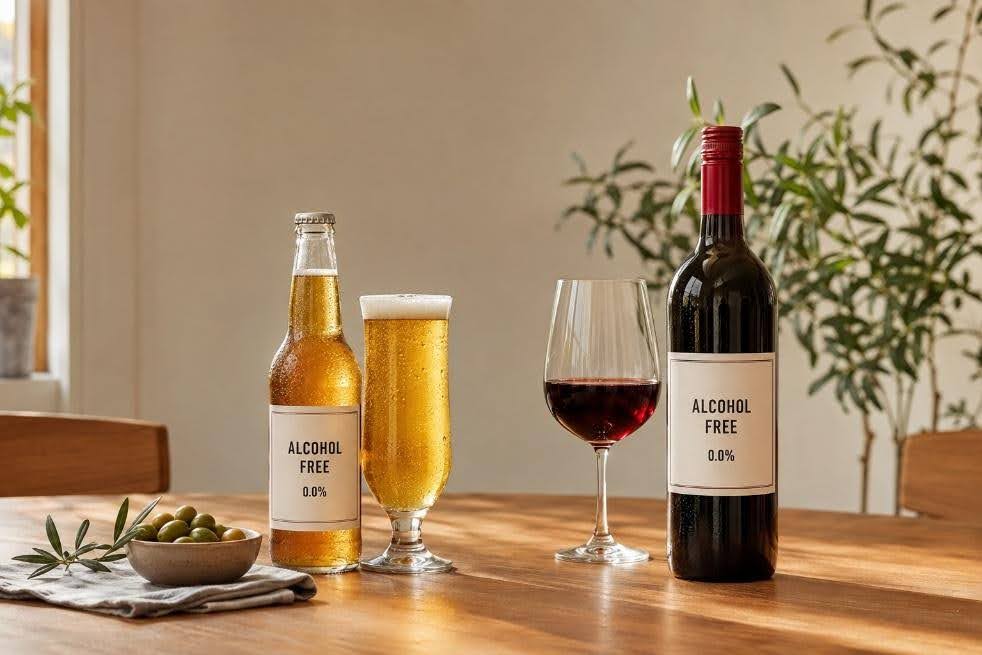
Alcohol-free wine and beer have become fashionable—and, in many ways, this is a positive development. They allow people to enjoy the ritual of opening a bottle, sharing a drink, or relaxing at the end of the day without consuming much, or any, alcohol.
But there is a small nutritional trap hiding behind the reassuring words alcohol-free.
Removing the alcohol does not automatically remove the sugar, carbohydrates, or calories. It may make the drink safer than its alcoholic equivalent, but it does not turn it into water.
Where the Calories Come From
Alcohol itself is surprisingly energy-dense, providing approximately seven calories per gram—almost twice the energy of carbohydrate or protein. This is why replacing conventional wine or beer with an alcohol-free version will usually reduce your calorie intake.
However, manufacturers still need the drink to taste pleasant. Removing alcohol can leave wine thin, sharp, or lacking body, so some products retain more residual grape sugar or use concentrated juice, flavourings, or added sweeteners. Alcohol-free beers can also contain carbohydrates remaining from the brewing process.
The result varies enormously. Some alcohol-free beers are relatively low in calories and sugar. Others, particularly flavoured beers, ciders, sparkling wines and alcohol-free cocktails, can be closer to sweetened soft drinks. Alcohol-free wine may contain substantially fewer calories than conventional wine, but drinking several generous glasses can still quietly add hundreds of calories to your evening.
There is also an important distinction between sugar and total carbohydrate. A beer may show very little “sugar” on its label while still containing other carbohydrates that contribute energy. Look at the entire nutrition panel—not just the sugar line.
The Health Halo Effect
The greater risk may be psychological.
Once something is labelled alcohol-free, low-fat, organic, or natural, we tend to grant ourselves permission to consume more of it. One glass becomes three because it feels harmless. A drink that was intended to replace alcohol becomes an additional nightly source of sweetness and calories.
This is the health halo effect: one favourable feature encourages us to stop evaluating the rest of the product.
Alcohol-free does not mean calorie-free. No added sugar does not mean sugar-free, because naturally occurring sugars may remain. And low sugar does not necessarily mean low carbohydrate or low energy.
Sugar does not become guilt-free simply because the alcohol has been removed. Your biology does not respond to the marketing language on the bottle. It responds to what is actually inside it—and how much of it you consume.
But Do Not Miss the Bigger Picture
It would be equally misleading to suggest that an alcohol-free wine containing some sugar is just as harmful as ordinary wine. It generally is not.
Alcohol is not simply another source of calories. It affects the brain, liver, blood pressure, sleep quality, coordination, and judgement. It can increase the risk of injury and several cancers, including breast, bowel, liver, oesophageal and head and neck cancers. The World Health Organization classifies alcohol as a carcinogen, and the risk generally increases as consumption rises. WHO
Alcohol may initially make you feel sleepy, but it can reduce restorative sleep and cause more fragmented sleep later in the night. It can also weaken food decisions, stimulate appetite, and make the chips, cheese, or late-night dessert much harder to resist. The calories in the glass are therefore only part of the metabolic cost.
Replacing alcoholic drinks with alcohol-free alternatives can remove or substantially reduce these alcohol-related effects—even if the replacement still contains some sugar. In most cases, that is a significant net improvement.
Moderation Is Risk Reduction, Not Risk Elimination
Many people enjoy alcohol and have no desire to eliminate it completely. That is their choice, and moderation is clearly better than regular heavy drinking. But moderation should not be confused with biological protection.
Australian guidelines recommend no more than ten standard drinks per week and no more than four on any one day. Importantly, these are guidelines designed to reduce risk, not a guarantee that drinking below them is completely safe. The official advice is simple: the less you drink, the lower your risk. NHMRC
This is particularly relevant because our definition of moderation has a habit of drifting. A large home-poured glass may contain considerably more than one standard drink. Two glasses each evening becomes fourteen drinking occasions across the week—and potentially more than fourteen standard drinks.
Research in moderate-to-heavy drinkers has found that even a month without alcohol can improve blood pressure, body weight, and insulin resistance. Reducing intake can also lower blood pressure, particularly among people who previously drank at higher levels. BMJ Open, systematic review
Do Not Remove the Social Connection
There is another side to this discussion that should not be ignored. A glass of wine at the end of the day, shared over a meal with family or friends, may provide relaxation, laughter, conversation, and a sense of belonging. These are not trivial benefits. Strong social relationships are consistently associated with better health and longer life.
The Longevity Blue Zones often highlight moderate wine consumption as one of the habits found in some long-lived communities. But we must be careful not to confuse association with causation. These people do not usually drink alone in front of the television. They drink small amounts slowly, with food, surrounded by family and friends, within communities where people feel connected, valued, and remembered.
Perhaps it is not primarily the wine adding years to their lives. Perhaps it is the conversation, the laughter, the slower meal, the release of stress and the feeling that someone notices whether they turn up tomorrow.
Wine may be present in the photograph, but that does not prove it created the longevity.
This is where alcohol-free wine and beer may offer a useful compromise. They allow us to retain much of the ritual and social connection while substantially reducing or eliminating the alcohol. You can still raise a glass, participate in the occasion and enjoy the end-of-day transition without pretending that ethanol itself is a longevity supplement.
The lesson should not be to eliminate the people, pleasure, and ritual from our lives. It is to separate the genuine benefits of connection from the biological risks of alcohol. Keep the friends, the shared table, the stories, and the laughter. Whether alcohol needs to be in the glass is another question entirely.
Effect of Alcohol on Bone Health
Replacing alcoholic wine or beer with an alcohol-free alternative may also benefit your bones. Regular or excessive alcohol can interfere with bone-building cells, calcium, and vitamin D metabolism, while also weakening muscle, balance, and coordination.
Reducing alcohol therefore supports healthier bone maintenance and lowers the chance that a stumble becomes a serious fracture. The greatest benefit may not be stronger bones alone, but the combination of better balance, improved muscle recovery, and a lower risk of falling.
Choose the Trade-Off Consciously
If an alcohol-free beer replaces a full-strength beer, or alcohol-free wine replaces conventional wine, it is usually a worthwhile exchange. You may consume some sugar and calories, but you have removed the ethanol—and that is the larger health win.
The problem arises when alcohol-free drinks are treated as unlimited hydration, consumed in addition to normal alcohol, or used to replace one nightly habit with another equally automatic one.
A practical approach is to:
- Compare calories, total carbohydrate, and sugar per 100 millilitres.
- Check the serving size rather than relying on the figures for an unrealistically small glass.
- Choose dry, lower-sugar varieties where possible.
- Retain the healthy habit of alternating alcoholic or alcohol-free beverages with sparkling mineral water, herbal tea, or plain water.
- Keep alcohol-free drinks as an occasional social substitute rather than a compulsory nightly reward.
- Notice whether they reduce your desire for alcohol or keep the drinking habit permanently switched on.
For people recovering from alcohol dependence, alcohol-free drinks can sometimes trigger cravings because the taste, bottle and ritual remain familiar. Individual advice may be helpful in that situation.
The Important Principle
Eliminating or reducing alcohol does not require nutritional perfection to be worthwhile.
An alcohol-free drink containing some sugar is generally still a better choice than the alcoholic version it replaces. But “better” does not mean “unlimited,” and “alcohol-free” does not mean free of consequences.
The goal is not to exchange one misleading health halo for another. It is to understand the trade-off, read the label and make the choice deliberately.
Removing alcohol is a substantial positive signal. Reducing unnecessary sugar and calories as well makes it an even better one.