Falls are easy to dismiss—until one changes the direction of a life.
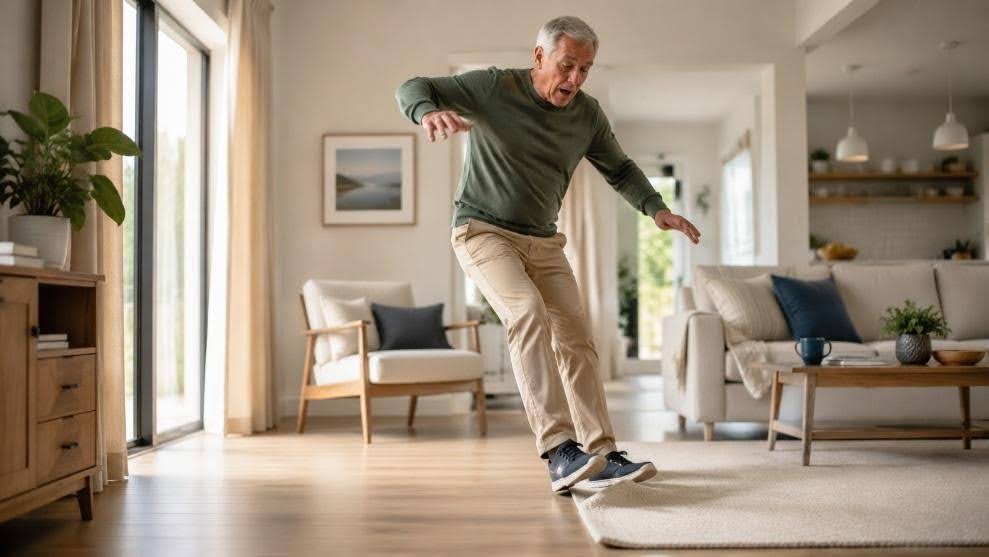
We tend to imagine serious falls as dramatic events: tumbling down a staircase, falling from a ladder, or slipping from a great height. In reality, many begin with something almost laughably ordinary—a loose rug, an unnoticed step or reaching for a book.
Barry Humphries described catching his foot on a rug while simply reaching for a book. He fractured his hip, required hip-replacement surgery, and later died following medical complications. Celebrated Australian fashion designer Carla Zampatti was 78 when she fell on stairs at an outdoor opera performance in Sydney. She lost consciousness and died in hospital a week later. More recently, British television host Piers Morgan tripped on what he called a “small step” in a London restaurant. At only 60, he fractured the neck of his femur, required a hip replacement, and spent six weeks on crutches—while joking that he blamed Donald Trump.
The humour helps, but the lesson is serious: a small obstacle can have an enormous consequence.
It Is Rarely “Just a Fall”
When we are younger, we usually bounce, swear, brush ourselves off and hope nobody noticed. As we grow older, the same fall can produce a fractured wrist, shoulder, pelvis, or hip—or a blow to the head.
Around one in four Australians aged 65 and over falls at least once each year. In 2024–25, older Australians were hospitalised because of falls at 12 times the rate of adults aged 25–44. Most hospitalisations among older people were caused not by spectacular accidents, but by ordinary slips, trips, and stumbles on the same level. Healthdirect, Australian Institute of Health and Welfare
One fall can also begin a downward spiral:
Fall → pain or injury → fear of falling → less movement → weaker muscles and poorer balance → greater risk of another fall
Even without a fracture, people may lose confidence and stop walking, shopping, travelling, or participating in social activities. They move less because they are frightened of falling, yet moving less makes another fall more likely.
That is the cruel irony: trying to stay safe by doing less can ultimately make us less safe.
A pattern also often emerges after the first fall. Research does not support a fixed progression of one fall this year, three the next and five after that, but it does show that falling once approximately doubles the likelihood of falling again.
Among older people who fall, more than 40% experience at least one further fall within the same year. The first fall should therefore be treated as a warning, not dismissed as clumsiness or bad luck. Unless the underlying causes—such as declining strength, poor balance, impaired vision, medication effects, or hazards around the home—are addressed, one fall can become the beginning of a recurring and increasingly dangerous cycle.
You Do Not Need to Be “Old”
Piers Morgan was 60—not an age most people consider elderly—when one small step resulted in a new hip. Falls do not wait until we reach a particular birthday. The decline in muscle strength, balance, coordination, and reaction speed can begin much earlier, particularly if we spend most of our lives sitting.
The warning signs are often subtle:
- Using your hands to rise from a chair
- Avoiding stairs or always reaching for the handrail
- Feeling unsteady when turning quickly
- Shuffling gait rather than steady heel-to-toe walking
- Struggling to stand on one leg for more than a few seconds
- Becoming hesitant on uneven ground
- Having one fall and dismissing it as bad luck
Sometimes it was bad luck. But repeated falls should never be regarded as normal ageing. They are a warning that something needs attention.
No Tablet Can Train Your Balance
Medicines can treat many conditions, and osteoporosis medications may marginally reduce fracture risk in appropriate patients. However, no tablet can teach your nervous system to react quickly when you trip. No supplement can practise standing on one leg, restore lost coordination or balance or create the leg strength required to catch your body before it hits the floor.
Balance is a skill. Strength is a physical reserve. Both must be used if they are to be retained.
This is the use it or lose it principle in its clearest form. If you regularly challenge your muscles, bones and balance, your body receives a reason to preserve them. If you avoid these challenges, your body gradually decides they are no longer required.
Biology is economical. It does not maintain expensive tissue and abilities that you never use.
Why Knowing This Is Not Enough
Most people already know that exercise is good for them. The problem is rarely a complete lack of information. It is fitting conventional exercise into an already busy life.
Driving to a gym, finding parking, changing clothes, completing a one-hour program, showering, and driving home two or three times each week can become a substantial commitment. Add work, family, appointments, and the occasional desire to have a life, and the program is often the first thing to disappear.
That does not make people lazy. It means inconvenience is a genuine barrier—and a health strategy that is not consistently used cannot produce a result.
A More Time-Efficient Option
This is one reason OsteoStrong® appeals to people who are unlikely to follow a conventional gym program. A supervised OsteoStrong® session generally takes around 15–20 minutes once a week and is designed to provide high-intensity osteogenic loading while also challenging strength, stability, and neuromuscular control.
The Swedish BONEMORE randomised controlled trial compared nine months of OsteoStrong—approximately 20 minutes once weekly—with a dynamic multicomponent exercise program performed for 60 minutes twice weekly. Both groups improved grip strength, back strength, trunk endurance, gait speed, and sit-to-stand performance.
The conventional exercise group produced only slightly greater improvements in gait speed, back endurance, and one-leg balance, but the time commitment was 6 times greater every week. Importantly, OsteoStrong® still demonstrated benefits in these strength measures. For time poor people who will not consistently complete two hours of conventional exercise each week, that practical difference matters a lot. BONEMORE study
OsteoStrong® need not replace walking, recreational activity or simple balance practice. It can provide a manageable foundation, particularly for people who want to improve strength but dislike gyms, have limited time or need a safer and closely supervised approach.
Reduce the Hazards and Build the Body
Fall prevention should work from both directions.
First, make the environment safer. Remove loose rugs and carpet squares, improve lighting, use handrails, manage electrical cords, choose supportive footwear, and have eyesight and hearing checked. Review medications with your doctor if you experience dizziness or unsteadiness.
Then make the person more capable. Improve leg and trunk strength, practise balance, maintain mobility and continue walking regularly. A safer home is valuable, but we cannot remove every step, kerb, slippery surface, or badly positioned café chair from the world.
The stronger and more responsive your body is, the better your chance of recovering from the unexpected.
What Will You Do About It?
You do not need to become a gymnast, live in the gym, or spend your days worrying about falling. You simply need a plan that is realistic enough to continue.
Start with something:
- Test how easily you can stand from a chair without using your hands – you should be able to complete 5 sit-to-stand repeats in under 17 seconds.
- Practise balance near a stable support.
- Walk regularly and deliberately.
- Have your vision, hearing and medications reviewed.
- Remove obvious hazards from your home.
- Find a strength and balance program you will actually attend consistently.
- Consider OsteoStrong® if time, confidence, or conventional gyms have been barriers.
A fall may happen in a second, but the physical capacity that helps prevent it is built over months and years.
Doing nothing is also a decision. It is a decision to gamble that your present strength, balance, and reaction speed will somehow remain available without being trained. Biology has never offered that guarantee.
The goal is not to become frightened of falling. It is to become better prepared to stay on your feet—and, when the occasional rug or small step tries to embarrass you, to give your body a fighting chance.