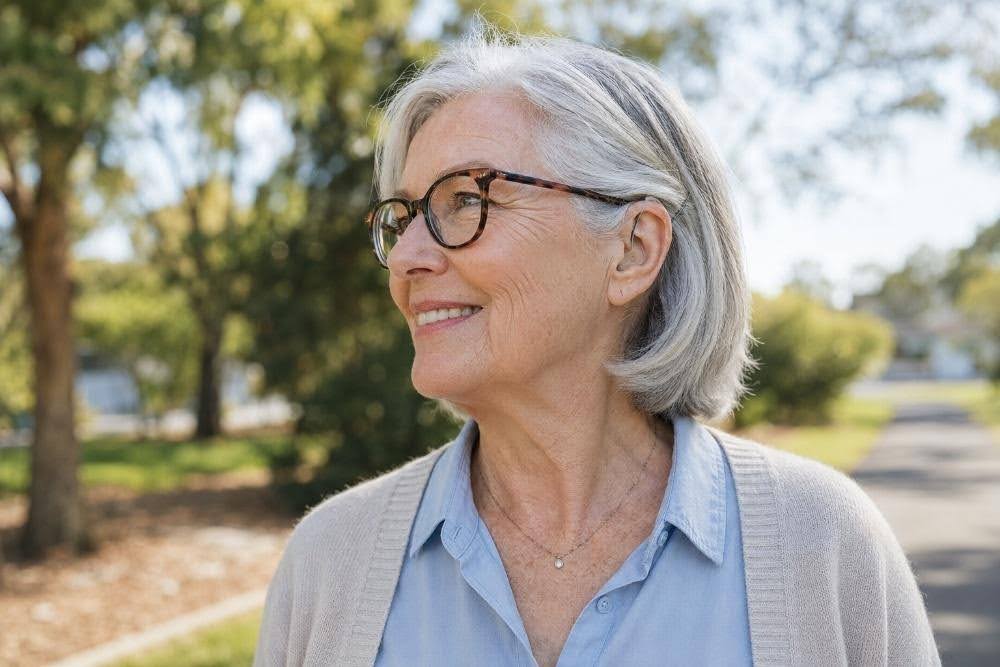
As we grow older, conversations about falls usually focus on balance, muscle strength, medications, loose rugs, and the family dog sleeping in precisely the wrong place. These all matter, but two other contributors are easily overlooked: whether we can clearly see the obstacle and hear what is happening around us.
Vision and hearing help us judge distance, recognise changes in surfaces, locate movement, and understand our position in the environment. Because these senses often decline gradually, we may not notice how hard the brain and body are working to compensate.
The right glasses or hearing aids cannot guarantee that we will never fall. However, regular eye and hearing assessments may identify treatable problems before they contribute to reduced confidence, inactivity, falls, and fractures.
Falls Are Common—but Not Inevitable
Up to one third of people aged 65 and over experience at least one fall each year. In Australia during 2024–25, people aged 65 and over were hospitalised because of falls at 12 times the rate of adults aged 25–44. Falls remain the leading cause of injury hospitalisation and injury death among older Australians. Australian Institute of Health and Welfare
These figures should not frighten us into moving less. Inactivity weakens the muscles, bones and balance systems needed to prevent a fall and limit the damage if one occurs.
The better response is to address the risks we can change. Muscle strength, balance, bone health, medication use, footwear, lighting, vision, and hearing all contribute.
You cannot avoid what you cannot see—or respond to what you cannot hear.
Vision Is Part of Balance
Vision does much more than help us read or recognise a friend. It allows us to judge the height of a step, see the edge of a kerb and decide whether the ground ahead is flat or uneven.
Aging can affect visual acuity, depth perception, peripheral vision, contrast sensitivity, and the ability to adjust between bright and dim environments. Cataracts, glaucoma, macular degeneration, diabetic eye disease, and outdated glasses can all contribute.
Contrast sensitivity is particularly important. Someone may still read an eye chart but struggle to see a grey step against a grey floor. That cream rug may be a tasteful decorating choice, but when it disappears into a cream carpet, it becomes a small domestic ambush.
Research has associated impaired vision with an approximately 20–27% greater risk of future falls. An Australian study of older adults waiting for cataract surgery found that 31% fell while waiting, and more than half of those falls caused an injury. NSW Agency for Clinical Innovation
Many visual problems can be corrected or managed, particularly when identified early.
Glasses Help—But Allow Time to Adjust
Correct glasses can make walking, driving, and recognising hazards much easier. However, a substantial prescription change can temporarily alter depth perception and the apparent height of stairs.
Multifocal lenses can be especially tricky when looking down because the reading section may blur the floor or distort a step. This does not mean older people should abandon multifocals. It means discussing lifestyle and fall risk with an optometrist. Someone who walks outdoors regularly may benefit from separate distance glasses.
After receiving a new prescription, practise in familiar, well-lit surroundings before launching onto a dim staircase carrying a washing basket.
Keeping lenses clean also helps a lot. The correct prescription is of limited value if we view the world through fingerprints, cooking vapour, and six months of accumulated mystery.
Hearing Helps Us Navigate
Hearing tells us about approaching traffic, bicycles, footsteps, warning signals, and moving objects. It also helps us identify direction and distance.
The hearing and balance systems are both located within the inner ear, although they are separate systems. Hearing loss does not automatically mean impaired balance, but shared age-related, neurological, or vascular problems may affect both.
Hearing loss also increases the mental effort required to understand the environment. If the brain is working harder to follow a conversation, it may have fewer attentional resources available for navigating obstacles and reacting quickly.
More than one-quarter of people aged over 60 have disabling hearing loss. World Health Organization A 2025 review involving 27 studies and more than five million people found that hearing loss was associated with a 17% greater future risk of falls. JAMA Otolaryngology
Hearing loss may not be the sole cause, but it is an important and potentially modifiable part of the overall picture.
Can Hearing Aids Help?
Hearing aids can improve communication, environmental awareness, and social participation. The evidence that they prevent falls has previously been mixed, partly because owning hearing aids and wearing them consistently are different things. A hearing aid living permanently in a bedside drawer is unlikely to warn anyone about a bicycle approaching from behind.
More recent evidence is encouraging. A three-year randomised trial found that a best-practice hearing intervention was associated with approximately 27% fewer falls than a health-education program. Hearing aids are not a standalone fall-prevention treatment, but they may contribute to safety as part of a broader strategy. The Lancet Public Health
Modern hearing aids are also smaller and more effective than many people imagine. They are no longer necessarily the large beige objects that whistle whenever someone gives you a hug.
If everyone is apparently mumbling, the television has become strangely quiet and restaurant conversations resemble competitive lip-reading, it may be time for a hearing assessment.
Reluctance to Use Glasses or Hearing Aids
For some people, wearing glasses or a hearing aid can feel like admitting they are getting older. Pride, appearance and the fear of being judged can all create resistance—but refusing support may have the opposite effect. Squinting, missing parts of conversations or repeatedly asking people to speak up can make us appear less confident and engaged.
It can also increase the risk of misunderstandings, social withdrawal, and falls. The good news is that glasses are no longer simply a sign of age: modern frames can be fashionable, character-building and a great expression of personal style.
Hearing aids have also changed enormously, with small and discreet options that are often barely noticeable. Seeing and hearing well helps us remain connected, independent, and safe—and confidence is always a better look than pretending we do not need a little help.
Strength and Balance Complete the Picture
Improving eyesight and hearing helps us detect hazards, but the body must still respond. Stronger legs, better balance, and faster reactions can help someone recover from a stumble before it becomes a fall.
At OsteoStrong®, we focus on improving muscle strength, balance and physical confidence through controlled, supervised loading and complementary balance activities. These improvements can contribute to reducing fall risk by helping members move more confidently and respond more effectively when they trip, slip or lose their footing.
It is a simple but important distinction: clear vision may help you see the step, hearing may alert you to what is approaching, and strength and balance may help you stay upright.
A Fall Does Not Have to Become a Fracture
Whether a fall results in a fracture also depends on bone strength, muscle mass, reaction speed and the force and direction of impact.
Vision and hearing may help prevent the initial fall. Strong muscles and better balance may improve the chance of recovering. Stronger bones may reduce the likelihood that the event becomes a life-changing fracture.
This is why fall prevention should never rely on one intervention. It involves the eyes, ears, brain, muscles, bones, medications, footwear, and physical environment working together.
Health is not simply additive; it is multiplicative. Several modest protections can combine to create a much larger benefit.
Make Check-ups Part of Healthy Aging
Have regular comprehensive eye examinations—generally at least every two years, or more often if advised because of age, diabetes, glaucoma risk, or existing eye disease.
Seek prompt assessment for sudden vision loss, flashes, new floaters, eye pain, double vision, or a curtain-like shadow across the visual field.
Arrange a hearing assessment if speech becomes unclear, television volume keeps increasing, tinnitus develops or family members repeatedly comment on your hearing. Sudden hearing loss, particularly in one ear, requires urgent medical attention.
When you receive new glasses, allow time to adapt and take extra care on stairs. When you receive hearing aids, wear them consistently and return for adjustments rather than deciding after two days that they do not work.
Use good lighting, highlight step edges, and remove unnecessary clutter. Avoid creating fifty shades of beige between the floor, rugs, stairs, and furniture.
Remove loose rugs, carpet squares, and other trip hazards wherever possible. What looks harmless can have life-changing consequences. Barry Humphries fractured his hip after catching his foot on a rug while reaching for a book—an ordinary domestic moment that led to hip-replacement surgery and a difficult recovery. He later died following medical complications. It is a sobering reminder that preventing a fall is far easier than recovering from one.
The Healthy Aging Message
Some loss of vision and hearing is common with age, but ignoring it should not be considered an unavoidable part of getting older. Many problems can be corrected, treated, or managed, and early action may protect much more than the senses themselves.
The right glasses may help you see the step. Hearing aids may help you notice what is approaching. Improved muscle strength and balance at OsteoStrong® may help prevent a stumble becoming a fall, while stronger bones may reduce the chance of a fracture if you do fall.
Keep the lenses clean, wear the hearing aids, turn on the lights, and continue strengthening the body that carries you through the world.
Healthy aging is easier when you can clearly see where you are going—and hear the family telling you that your glasses are on top of your head.